

Summarize this guide with your preferred AI tool
Note: If prompt prefill is restricted by your browser, paste the copied prompt directly into the AI tool.
Table of Contents
- 1. Why the Refund Amount Is Not the Full Cost
- 2. Direct Financial Impact of a Refund
- Refunded Gross Revenue vs. Economic Loss
- Non-Refundable Payment Processing & Interchange Fees
- Return Shipping & Carrier Surcharges
- Customer Support & RMA Labor
- 3. Indirect Financial Impact & Margin Leakage
- Inventory Depreciation & Open-Box Write-Downs
- Inspection, Cleaning & Repackaging Labor
- Lost Contribution Margin & Unrecoverable CAC
- 4. Refunds vs. Returns vs. Exchanges vs. Chargebacks
- 5. A Practical Formula for Total Refund Leakage
- The Critical Rule Against Double-Counting
- 6. Worked Illustrative Merchant Example
- 7. Calculating Cost per Order, per Product, and by Reason
- 8. Identifying Disproportionate Catalog Leakage
- 9. Prioritizing Corrective Actions by Financial ROI
- 10. Analyzing Refund Trends with RefundLens
- Frequently Asked Questions
- Conclusion
- About the Author
Key Financial Realities of Shopify Refunds
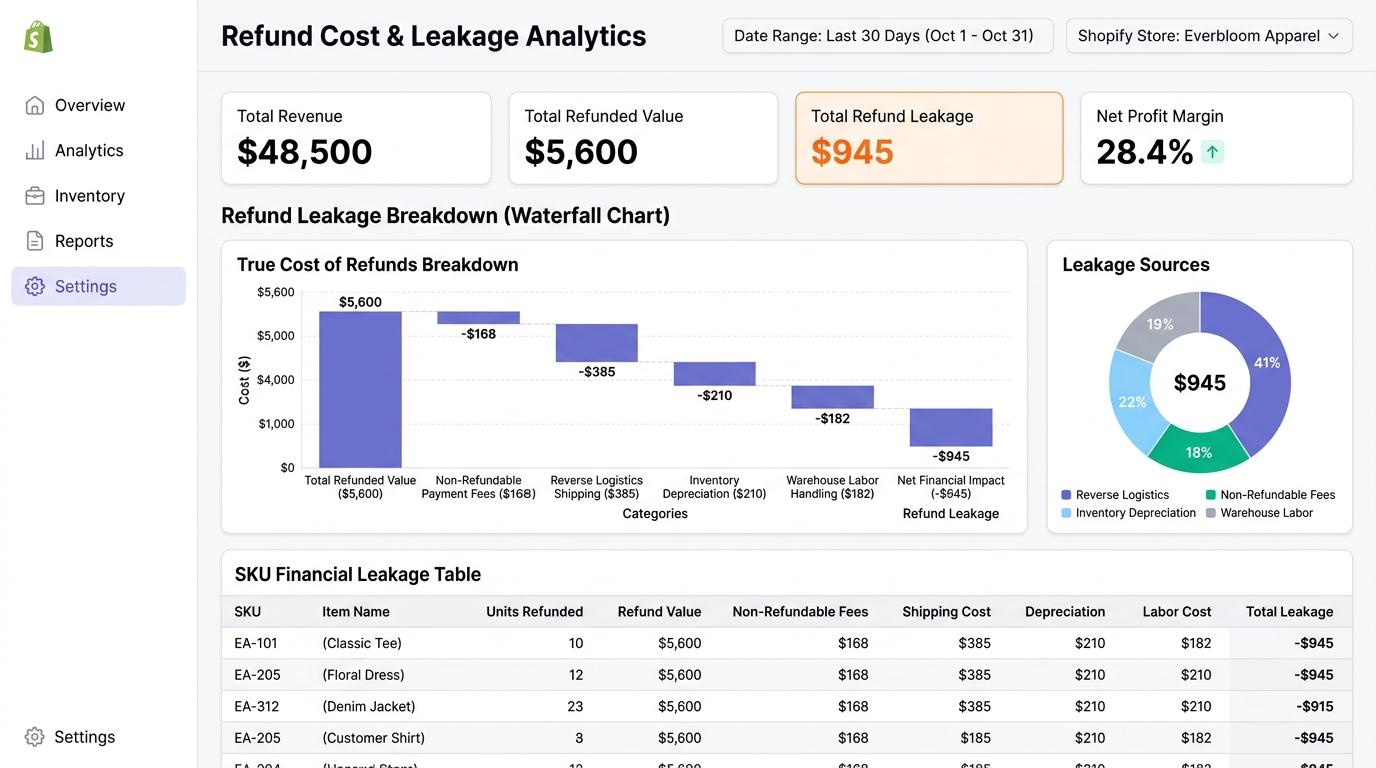
Most ecommerce operators equate the cost of a refund with the dollar amount returned to the customer. In financial accounting, that is only the reversal of gross revenue. The true operational cost of a refund includes unrecoverable payment gateway processing fees, outward and reverse shipping labels, warehouse grading and repackaging labor, inventory write-downs, and wasted customer acquisition spend. To accurately protect contribution margin, merchants must distinguish refunded gross cash flow from net economic leakage.
1. Why the Refund Amount Is Not the Full Cost of a Refund
In your Shopify Admin, when an order is refunded, the transaction registers as a deduction against gross sales. If a customer returns a $120 jacket, your top-line revenue decreases by $120. Many merchants view this event as simply returning to the financial starting line, as though the sale never occurred.
In operational reality, you never return to the starting line. A refunded order leaves behind an unrecoverable trail of sunken expenses. Payment processors retain authorization fees, shipping couriers charge for delivery and return transport, warehouse technicians spend billable minutes inspecting and bagging garments, and the physical merchandise depreciates while sitting in return transit.
Understanding your refund leakage, the total sum of non-refundable operational costs consumed by a refund, is essential for calculating true store profitability. If your store maintains a 20% return rate, understanding baseline return benchmarks across your vertical is critical. For broader industry context, explore our detailed analysis of Shopify refund rate benchmarks by industry.
2. Direct Financial Impact of a Refund
Direct costs are line-item cash disbursements generated immediately by the refund event. Every merchant issuing refunds on Shopify encounters four core direct financial factors:
Refunded Product Revenue vs. Actual Economic Loss
It is vital to distinguish between a revenue reversal and an economic loss:
One of the most persistent operational profit leaks in ecommerce stems from payment processing fee schedules. Historically, some merchant acquirers refunded credit card processing fees when a transaction was reversed. Over the past several years, however, major payment networks and merchant aggregators revised their terms of service to make payment processing fees non-refundable upon order cancellation or refund.
To calculate refund leakage accurately, merchants must distinguish between four distinct fee mechanisms:
According to the official Shopify Help Center (Shopify Payments refunds) and the Shopify Payments Terms of Service, when you issue a full or partial refund to a customer, the original credit card transaction fee is not refunded to the merchant. No additional fee is charged by Shopify for processing the refund itself, but the initial variable percentage (typically 2.4% to 2.9% depending on your plan and jurisdiction) and fixed per-transaction fee (e.g., $0.30) are permanently retained. Furthermore, if the original transaction involved currency conversion, currency conversion fees are also non-refundable.
Merchants using independent third-party payment gateways are bound by their external merchant processing agreements. Under current global terms, Stripe (policy updated in 2019) and PayPal (policy updated in 2019/2020) do not return credit card processing or fixed transaction fees when a merchant initiates a customer refund.
If your store uses an external payment gateway instead of Shopify Payments, Shopify charges an additional platform transaction fee (0.5% to 2.0% depending on your plan). Per official Shopify documentation, fee treatment depends on regional availability: in countries where Shopify Payments is not available, Shopify credits this third-party transaction fee back proportionally if the refund is executed through the Shopify Admin. However, in regions where Shopify Payments is available and a merchant voluntarily opts for an external provider, Shopify does not refund third-party transaction fees upon refund.
The underlying cost of a card transaction consists of interchange (paid to the card-issuing bank) and card brand assessment fees (paid to Visa, Mastercard, American Express). Because card networks charge clearing and authorization costs regardless of whether a purchase is subsequently returned, payment processors retain these fees rather than absorbing network clearing expenses on reversed volume.
On a $200 customer order processed through Shopify Payments at 2.6% + $0.30, the merchant incurs $5.50 in credit card processing fees. When the customer is refunded $200, the merchant must return the entire $200 from their account or future payouts, but Shopify Payments retains the $5.50 fee. Across $100,000 in refunded volume annually, non-refundable payment processing fees create an unavoidable $2,700+ cash drain.
*Tip: To avoid paying unrecoverable processing fees on orders cancelled immediately before fulfillment (such as flagged fraud or immediate buyer error), merchants can configure Shopify Payments to authorize charges and capture payment manually upon dispatch rather than automatically capturing funds at checkout.
If your store offers free returns or provides prepaid return shipping labels through commercial carrier integrations (USPS, UPS, FedEx, or DHL), return postage is a direct cash expense. While outbound bulk commercial parcel rates may average $6.50 to $9.00, individual return shipments often cost more due to:
- Single-piece return pickup surcharges: Residential collection fees added by carriers.
- Dimensional weight penalties (DIM weight): When customers return items in oversized boxes rather than original slim poly mailers.
- Fuel surcharges: Variable carrier fees that adjust weekly and apply to reverse logistics.
Customer service interactions cost real money. When a buyer initiates a return, your support team handles triage emails, troubleshoots fit concerns, verifies order numbers, and manually reconciles return authorizations. If an in-house support representative earning $22/hour spends an average of 8 to 12 minutes managing a complex return inquiry, the labor cost per refunded order is $2.93 to $4.40.
3. Indirect Financial Impact & Margin Leakage
Beyond immediate shipping labels and merchant processing fees, returned products generate indirect friction that erodes operating income:
Inventory Depreciation & Open-Box Write-Downs
Merchandise does not hold its value indefinitely while traveling through return channels. By the time a customer initiates a return, prints a label, hands the package to a carrier, and the warehouse receives and processes it, 2 to 4 weeks have elapsed. This transit lag creates distinct depreciation risks:
Warehouse Inspection, Cleaning & Repackaging Labor
Returned parcels cannot simply be placed back onto warehouse shelves. Reverse warehouse logistics is substantially more labor-intensive than forward picking. A warehouse associate must:
- Open and unbox the returned parcel.
- Perform quality control grading (checking for stains, pet hair, wear, odors, or missing accessories).
- Fold, steam, or sanitize the garment or wipe down electronics.
- Apply a new polybag, barcoded hangtag, or retail carton.
- Manually scan the unit back into Shopify inventory management.
Under standard ecommerce 3PL contracts, return intake, inspection, and restocking handling fees generally range between $2.50 and $5.50 per unit, with specialized apparel (e.g., steaming, refolding) or technical electronics diagnostics incurring higher fees.
Lost Contribution Margin & Unrecoverable Customer Acquisition Cost (CAC)
When you acquire a customer through paid advertising (Meta, Google Shopping, TikTok), you spend acquisition capital to generate that order. If your blended Customer Acquisition Cost (CAC) is $30 on an order that is subsequently refunded, that marketing capital was consumed without contributing a single dollar to fixed operating expenses. If that buyer does not purchase again, your net contribution on that customer is deeply negative.
Accounting Clarification: While unrecovered CAC represents lost contribution margin and unearned marketing return, it is an upfront customer acquisition expense rather than an incremental operational refund line item. In standard managerial accounting, CAC should be evaluated through blended marketing efficiency (MER) and customer lifetime value (LTV), rather than counted twice as a variable refund processing cost.
4. Financial Mechanics: Refunds vs. Returns vs. Exchanges vs. Chargebacks
Many merchants conflate post-purchase financial events. However, the cash flow, revenue recognition, and operational overhead differ dramatically across these four distinct transactions:
| Transaction Type | Gross Revenue Impact | Physical Inventory | Payment Fee Impact | Net Cash Flow Effect |
|---|---|---|---|---|
| Cash Refund | 100% Reversed | Restocked or written off | Processing fees retained by gateway | Negative (Cash disbursed + unrecovered fees) |
| Variant Exchange | 100% Retained | Original restocked; new unit shipped | Zero additional gateway fee | Preserved margin (less exchange shipping/labor) |
| Store Credit | Retained in Balance | Restocked for resale | Zero gateway refund deduction | Preserved store liquidity |
| Chargeback Dispute | Forced Clawback | Often lost / unreturned | +$15 to $25 dispute penalty fee | Severe loss (Product + Cash + Bank Fine) |
5. A Practical Formula for Calculating Total Refund Leakage
To calculate true refund leakage across your Shopify store, use a standard operational cost formula that captures each friction component without double-counting revenue:
A frequent error made by inexperienced operators is adding both the gross refund amount and the product cost (COGS) together as simultaneous losses.
Example: If a dress retailing for $100 costs $35 to manufacture, and the customer returns it in pristine condition, you do not lose $135 ($100 refund + $35 COGS). When you disburse the $100 refund, you reacquire the $35 inventory asset on your balance sheet. Your net financial loss is the operational handling friction (fees + shipping + labor = ~$14) plus the opportunity cost of lost contribution margin. If the dress is damaged and discarded as unresellable, your true cash loss is the operational friction ($14) plus the wholesale asset write-down ($35) = $49, not $135.
6. Worked Illustrative Merchant Example (Clearly Labeled Hypothetical Figures)
To illustrate how refund leakage impacts monthly contribution margin, review this hypothetical DTC apparel merchant scenario:
Monthly Sales: 1,000 orders | Average Order Value (AOV): $100 | Gross Monthly Sales: $100,000 | Return Rate: 15% (150 returned orders) | Store policy: Free returns with prepaid labels.
| Cost Component | Assumed Rate / Unit Cost | Monthly Financial Impact (150 Returns) |
|---|---|---|
| Gross Refund Disbursed | $100.00 refunded per order | $15,000 (Top-Line Revenue Reversal) |
| 1. Non-Refundable Processing Fees | 2.6% + $0.30 per order = $2.90 | $435.00 |
| 2. Return Shipping Labels | $7.50 average commercial return label | $1,125.00 |
| 3. Warehouse Inspection & Repackaging | $3.00 labor + polybag/tag supplies | $450.00 |
| 4. Customer Support Triage Time | $2.00 (6 mins support time @ $20/hr) | $300.00 |
| 5. Inventory Markdown / Write-Down | 15% of units (22.5 units) incur markdown/scrap @ $12/unit ($1.80/order weighted across all 150 returns) | $270.00 |
| Total Operational Refund Leakage | $17.20 true loss per returned order | $2,580.00 / month |
Takeaway: Beyond the $15,000 reversal in sales revenue, the merchant lost an additional $2,580.00 in direct cash expenses ($17.20 per returned order) that cannot be recovered.
7. How to Calculate Refund Cost per Order, per Product, and by Reason
Storewide refund leakage metrics provide high-level clarity, but actionable remediation requires calculating costs across three granular operational dimensions:
Divide your total monthly refund operational leakage (fees + return shipping + warehouse labor) by the count of refunded orders. This gives you your baseline operational penalty per return incident.
Multiply an individual SKU’s unit refund count by its specific reverse freight, repackaging requirements, and open-box depreciation rate. For a methodology on locating high-impact products, see our guide on finding high-refund products.
Cluster total leakage by underlying reason codes. Returns for “damaged in transit” carry higher inventory write-offs than “wrong size” returns where the garment is restocked. Review our analysis of common Shopify refund reasons.
8. Identifying Products & Variants with Disproportionate Refund Costs
Not all products create equal financial damage when returned. Two items with the identical 15% return rate can produce wildly divergent bottom-line margin erosion:
A returned silk scarf costs $4.80 in first-class postal return transit and fits back into a 4x6 polybag. A returned solid oak coffee table incurs $85 in LTL freight, requires pallet strapping, and often suffers corner scuffs that necessitate a 50% discount in an open-box warehouse sale.
Ceramics, glassware, and bottled liquids frequently break in transit. When a bottle of toner leaks inside a parcel, the item cannot be refurbished; the merchant loses 100% of the product wholesale cost in addition to shipping appeasements.
9. Prioritizing Corrective Actions by Financial ROI
Because catalog management and warehouse operational hours are finite, merchants must prioritize catalog fixes using estimated financial recovery rather than raw return percentages:
A low-volume novelty item with a 40% refund rate that sells 10 units a month generates far less financial damage than your store’s core hero bestseller with a 14% refund rate selling 2,000 units a month. Always remediate catalog documentation, photography, and packaging on products generating the highest absolute dollar leakage first. Learn the full framework in our guide to analyzing Shopify refunds step by step.
10. Analyzing Refund Leakage Trends with RefundLens
Tracking refund leakage manually across multiple spreadsheets, 3PL invoices, and Shopify order exports is labor-intensive and reactive. By the time a merchant aggregates monthly returns into an accounting model, thousands of dollars in preventable margin leakage have already escaped.
RefundLens: AI Refund Insights connects directly to your Shopify store via an automated data ingestion workflow. It tracks storewide, product-level, and variant-level refund metrics in real time. Using multi-dimensional refund diagnostic features, RefundLens clusters customer return reasons, identifies SKUs with high return volume, applies automated Shopify Admin product tags to flag emerging risks, and exports structured CSV reports for financial reviews.
RefundLens is an analytics, diagnostic, and reporting intelligence application. It does not provide a customer-facing returns portal, does not print shipping labels, does not automate financial refund disbursements, and does not promise guaranteed profit recovery or automated fraud elimination. Its purpose is to deliver accurate catalog diagnostics so merchants can make informed operational decisions.
Frequently Asked Questions About the True Cost of Shopify Refunds
Does Shopify refund credit card processing fees when an order is refunded?
Under standard Shopify Payments terms in the United States and most international jurisdictions (updated in 2019/2020), original credit card transaction fees (e.g., 2.4% to 2.9% + $0.30) are not returned to the merchant when a refund is issued, though Shopify charges no extra fee to execute the refund. For stores using external payment gateways, third-party processors like Stripe and PayPal similarly retain processing fees. Shopify's additional third-party transaction fee (0.5% to 2.0%) is only credited back on refunds if Shopify Payments is unavailable in the merchant's country.
What is the difference between refunded revenue and actual economic loss?
Refunded revenue represents the gross dollar amount returned to the customer, reversing the initial sale. Actual economic loss represents the net cash destroyed by the transaction: non-refundable payment fees, two-way shipping, warehouse intake labor, repackaging, and any physical inventory write-down if the product cannot be resold at full price. If a product is restocked in new condition, the merchant loses the profit margin and operational handling costs, not the full retail value plus the inventory cost.
How do you avoid double counting when calculating refund costs?
Never add the refunded retail price and the product manufacturing cost (COGS) together as separate losses. When an order is refunded, the customer receives their purchase price back. If the item is returned in restockable condition, the merchant reclaims the physical asset; their loss is handling costs plus lost contribution margin. If the product is discarded as damaged, the merchant's loss is handling costs plus the wholesale inventory asset value (COGS), not the retail price plus COGS.
Does every refund incur return shipping expenses?
No. Return shipping is only incurred when physical merchandise is shipped back to the merchant using a store-funded prepaid label. Many refunds occur without return shipping, such as order cancellations prior to dispatch, returnless customer service appeasements for inexpensive damaged goods, digital product refunds, or when the return policy requires the customer to pay for their own return postage.
Is there a universal average cost for ecommerce returns?
No. A universal return cost does not exist because return economics depend entirely on average order value (AOV), product weight, return freight rates, restocking labor efficiency, and category depreciation. A high-ticket jewelry item costs very little to ship and restock relative to its value, whereas a bulky freight sofa or low-margin perishable good incurs catastrophic reverse logistics costs relative to product price.
How can Shopify merchants reduce the financial leakage of returns?
Merchants can reduce refund leakage by fixing catalog inaccuracies that trigger preventable returns (sizing charts, undertone photography), encouraging variant exchanges or bonus store credit rather than cash refunds, negotiating tiered carrier return rates, and identifying individual SKUs that suffer disproportionate reverse logistics damage.
Conclusion
Evaluating refunds strictly as top-line revenue reversals obscures their true impact on ecommerce profitability. Behind every refund lies a compounding stack of operational friction: non-refundable merchant fees, freight transport, warehouse intake labor, repackaging supplies, and inventory markdowns.
By modeling true refund leakage, avoiding double-counting revenue against inventory, and prioritizing catalog improvements on products causing disproportionate financial damage, Shopify merchants can turn return analytics into a powerful driver of sustainable contribution margin.

Ketul Sindhwad
Digital Marketing & SEO Professional
Ketul Sindhwad is a Digital Marketing & SEO professional focused on ecommerce, analytics, and Shopify. He shares practical guides on understanding customer behavior, product performance, refunds, and other data that can help merchants make better decisions.